8 But immediately, when Jesus perceived in His spirit that they reasoned thus within themselves, He said to them, “Why do you reason about these things in your hearts? 9 Which is easier, to say to the paralytic, ‘Your sins are forgiven you,’ or to say, ‘Arise, take up your bed and walk’? 10 But that you may know that the Son of Man has power on earth to forgive sins”—He said to the paralytic, 11 “I say to you, arise, take up your bed, and go to your house.” [Mark 2:8-11]
The title “Son of Man” is one of the most profound yet most misunderstood expressions that Jesus used to describe Himself in His earthly life. While many think that the phrase simply highlights His humanity, the biblical and historical reality of the title reveals far more than Jesus being just a human. When understood through the lens of both Old and New Testament revelation, the title emerges as one of the strongest and clearest affirmations of the deity of Christ.
In this study, drawing from the Old Testament and New Testament, and examining the Jewish Second Temple literature, we will explore the meaning, background, and theological significance of the title, demonstrating why it stands as irrefutable evidence of the divine sonship and deity of Christ.
Recommended: Son of God: 7 Undeniable Evidence for the Deity of Christ
The Meaning and Background of the Title “Son of Man”
To appreciate the weight of Jesus’s title as “Son of Man”, we must begin with its biblical and historical roots. To be clear, Jesus did not invent the title. He inherited it from a rich biblical and prophetic tradition. This background shapes everything that comes afterwards.
The Old Testament Roots of the Title
To start with, many have argued that the concept of the divine sonship and deity of Christ is absolutely a New Testament innovation, that He was never referred to as a Son (of God) in the Old Testament. But that is clearly false and misleading. Because in the Old Testament, God was definitely spoken of as having a son.
Proverbs 30:4:
“Who has ascended into heaven, or descended? Who has gathered the wind in His fists? Who has bound the waters in a garment? Who has established all the ends of the earth? What is His name, and what is His Son’s name, if you know?”
This text proves that the divine sonship of Jesus was not a New Testament creation as many think—but right from the Old Testament, the identity of Jesus as Son had been revealed. Having established this critical truth, now let’s go on to see the origin of Jesus’s most popularly used title “Son of Man”.
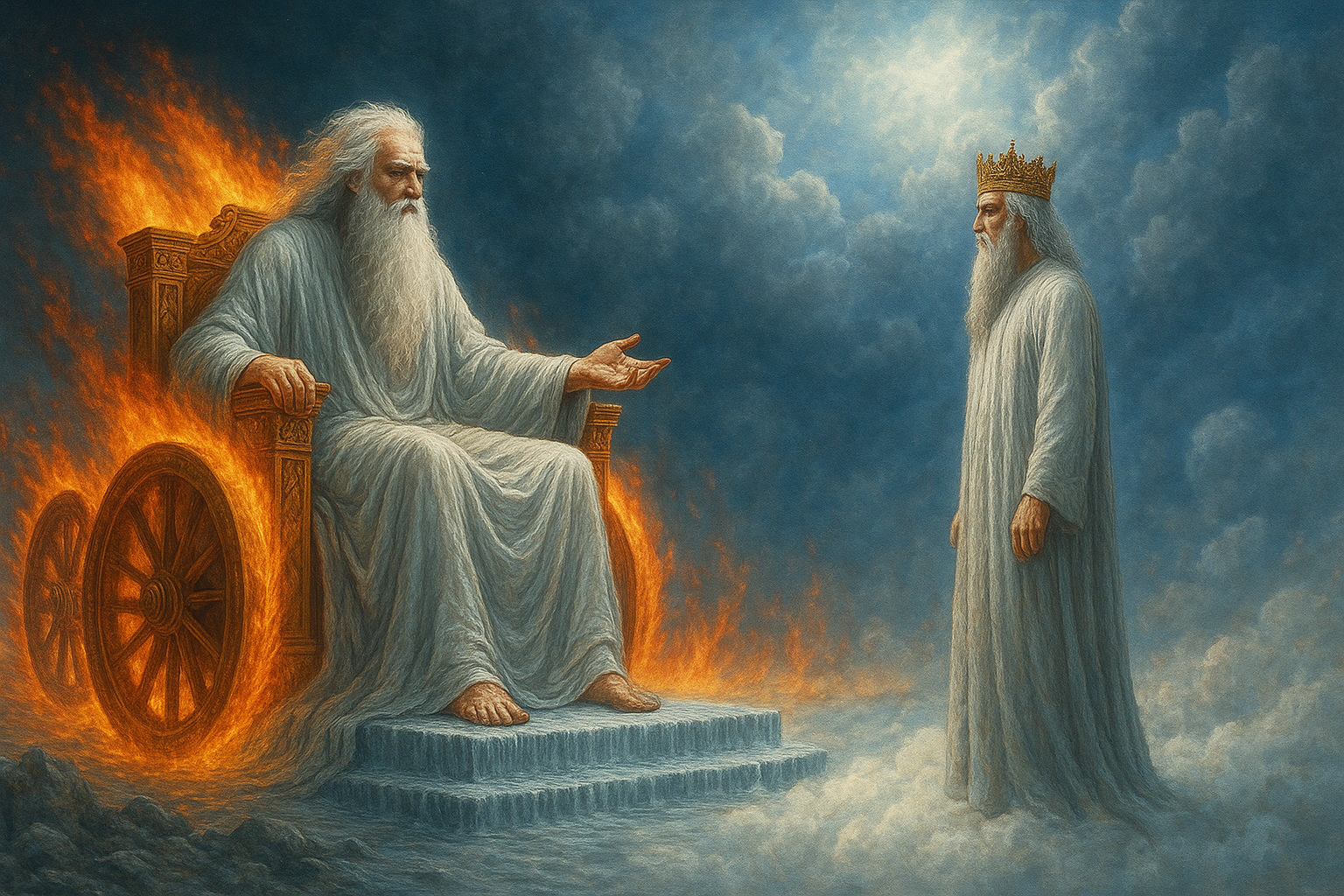
Again, the identity of Jesus as “Son of Man” started right from the Old Testament Scripture. The clearest Old Testament origin of the title appears in Daniel 7:13–14, in a vision of Daniel the prophet, where he (Daniel) saw “One like the Son of Man” coming with the clouds of heaven.
13 I was watching in the night visions, and behold, One like the Son of Man, coming with the clouds of heaven! He came to the Ancient of Days, And they brought Him near before Him. Then to Him was given dominion and glory and a kingdom, That all peoples, nations, and languages should serve Him. His dominion is an everlasting dominion, Which shall not pass away, And His kingdom the one which shall not be destroyed.
There are many very interesting things to note in this text. The first is that this vision was a heavenly vision—that is, the location of what Daniel saw was heaven, not earth. All the beings that Daniel saw in the vision, including the One referred to as the Son of Man, are heavenly beings, not earthly, human beings.
Secondly, two distinct Beings were specifically mentioned in the text, whom Daniel saw—One referred to as the Ancient of Days. This Being had been mentioned earlier in verses 9, where Daniel said:
“I watched till thrones were put in place, and the Ancient of Days was seated; His garment was white as snow, and the hair of His head was like pure wool. His throne was a fiery flame, Its wheels a burning fire.”
Bible scholars are unanimous about the identity of this Being as God the Father. He is portrayed as an aged being with pure white hair and apparel, sitting on a fiery throne, overseeing the judgment of kingdoms of the earth. His being called the Ancient of Days signifies His eternality, wisdom, and absolute authority.
The second Being shown in Daniel’s vision was another heavenly being referred to as the Son of Man. He was shown as coming to the Ancient of Days, riding on the clouds of heaven. Then, in a display that showed His importance, He was accompanied, probably by angels or some celestial beings, into the presence of the God the Father, from whom He received dominion, glory, and a kingdom that will never pass away.

This description is not that of a mere human. Three elements make this Being unmistakably divine:
1. He came with the clouds of heaven, a theme that is associated exclusively with God in the Old Testament.
2. He receives an eternal, universal dominion from the Ancient of Days, something no angel, or a prophet or messianic king in the Old Testament ever received.
3, His kingdom is everlasting. This is a characteristic of divine rule alone. Isaiah in his messianic prophecy in Isaiah 9:7, said this same thing.
“Of the increase of His government and peace there will be no end…”
The Second Temple Era Literature
Jewish writings during the intertestamental period—that is, the period between Malachi and Matthew, confirm that many Jews interpreted the Son of Man in Daniel’s vision as a preexistent heavenly being. Texts like 1 Enoch describe the Son of Man as a cosmic judge and an eternal ruler.
This means that in Jesus’ day, the title did not mean “ordinary human”, as some people wrongly thought. Instead, it pointed to a heavenly Messiah possessing divine authority.
The First-Century Jewish World
In first-century Judaism, the Son of Man was anticipated as a heavenly deliverer—a being sent from God with supernatural authority. This understanding means Jesus’ use of the title carried immediate messianic and divine implications. Hence, the negative reactions of most of His Jewish audiences when He used it.
The Son of Man title also held an intentional tension—the figure is, though heavenly and divine in nature, yet human. Jesus used the title to reveal His dual nature in perfect harmony.
Jesus’s Use of the Title
When Jesus appeared on the earth scene and started to call Himself the Son of Man, He was invoking one of the most exalted, divine titles in Jewish Scripture. He was making a firm statement of His divine sonship and deity.
It is why it sounds absurd to me when people—Muslims, atheists, and untaught Christians—say that Jesus never claimed to be God. Oh, He did! Not in the 21st Century manner of speaking. But He did, in ways and through means that were unmistakable to first century Jews as to what He meant. And, that informed their violent reactions every time He used these terms.
Jesus used “Son of Man” over eighty times—more than any of His other designations, including Son of God. This was not incidental. It was a deliberate Christological revelation.
The title was Jesus’ preferred expression of His identity. He rarely introduced Himself as Messiah or Son of God. He avoided the “Messiah” title because it was politically charged and misunderstood. But He frequently used Son of Man, because it allowed Him to reveal His deity gradually and on His own terms. The title carried a significance He wanted His followers and opponents alike to grasp.

Son of Man as Direct Evidence of Deity of Christ in the Gospels
In the Gospels, Jesus ties the title of Son of Man to His actions. For example, as the Son of Man, He forgives sins, which is a prerogative belonging only to God.
Mark 2:9–11:
9 Which is easier, to say to the paralytic, ‘Your sins are forgiven you,’ or to say, ‘Arise, take up your bed and walk’? 10 But that you may know that the Son of Man has power on earth to forgive sins”—He said to the paralytic, 11 “I say to you, arise, take up your bed, and go to your house.””
He is Lord of the Sabbath. whose authority supersedes the Scripture’s Sabbath laws.
Mark 2:28:
“Therefore the Son of Man is also Lord of the Sabbath.””
He will judge all nations—a role reserved for God alone.
Matthew 25:31–32:
31 When the Son of Man comes in His glory, and all the holy angels with Him, then He will sit on the throne of His glory. 32 All the nations will be gathered before Him, and He will separate them one from another, as a shepherd divides his sheep from the goats.
He gives life, which is what only God could do.
John 5:26–27:
26 For as the Father has life in Himself, so He has granted the Son to have life in Himself, 27 and has given Him authority to execute judgment also, because He is the Son of Man.
Each of these statements ties His authority directly to His being the Son of Man. But Jesus also linked the title to His death and resurrection. The Son of Man will reign only after suffering, then rising in glory.
Mark 8:31:
“And He began to teach them that the Son of Man must suffer many things, and be rejected by the elders and chief priests and scribes, and be killed, and after three days rise again.”
And, He linked the title to His return at the end of the world.
Matthew 24:29–30:
29 Immediately after the tribulation of those days the sun will be darkened, and the moon will not give its light; the stars will fall from heaven, and the powers of the heavens will be shaken. 30 Then the sign of the Son of Man will appear in heaven, and then all the tribes of the earth will mourn, and they will see the Son of Man coming on the clouds of heaven with power and great glory.”
Jesus also connected the title to His preexistence and heavenly origin. He says in John 3:13:
“No one has ascended to heaven but He who came down from heaven, that is, the Son of Man who is in heaven.”
And, He spoke of ascending back to where He was before.
John 6:61–62:
61 “When Jesus knew in Himself that His disciples complained about this, He said to them, “Does this offend you? 62 What then if you should see the Son of Man ascend where He was before?”
These are explicit declarations of preexistence—another divine attribute.
In Matthew 24 and 26, Jesus refers to Himself as the Son of Man who will come on the clouds of heaven with great power and glory. This is a direct claim to the Being in Daniel’s vision. And, Jesus says as the Son of Man, He will judge the nations, separate the righteous from the wicked, and gather His elect. Divine judgment belongs to God alone—yet Jesus claims it as His role.
Recommended: Learning Christ: 12 Key Qualities of a Teachable Christian
Son of Man: Jesus’s Exaltation in the New Testament
In the New Testament, Jesus is consistently shown as exalted and glorified, in a manner that a mere human cannot be exalted and glorified. For example, in Stephen’s vision in Acts 7:55–56, the ascended Jesus, whom Stephen identified as the Son of Man is enthroned at the right hand of God the Father.
55 But he, being full of the Holy Spirit, gazed into heaven and saw the glory of God, and Jesus standing at the right hand of God, 56 and said, “Look! I see the heavens opened and the Son of Man standing at the right hand of God!”
Stephen’s vision as he was dying shows the Son of Man —the ascended and glorified Jesus standing at the right hand of God. The “right hand of God” figuratively denotes a position of power, authority and equality. If Jesus, the Son of Man, shares God’s throne, then He shares God’s authority, identity, and worship.
In Revelation 1, the Apostle John describes the exalted Christ in divine terms. See verses 12–15:
12 Then I turned to see the voice that spoke with me. And having turned I saw seven golden lampstands, 13 and in the midst of the seven lampstands One like the Son of Man, clothed with a garment down to the feet and girded about the chest with a golden band. 14 His head and hair were white like wool, as white as snow, and His eyes like a flame of fire; 15 His feet were like fine brass, as if refined in a furnace, and His voice as the sound of many waters.
In Revelation, the Son of Man—the exalted Christ receives worship, judges the world, defeats evil, and reigns forever—all of which are divine functions.
Why This Remains A Powerful Apologetic For Jesus’ Deity Today
The title of Son of Man affirms both the deity of Christ and His humanity. The title perfectly expresses the mystery of the incarnation: true humanity and full deity unified in one person.
The proper understanding of Jesus’s title of Son of Man produces a balanced Christology. It safeguards against the errors of reducing Jesus to a mere good human teacher or denying His genuine humanity.
Grasping the Son of Man title deepens faith and enhances confidence in Christ’s divine authority. Those who claim Jesus never made the claim of deity either misunderstand the Son of Man title or miscellaneously ignore it. A proper understanding refutes such claims convincingly.
In conclusion, the Son of Man title reveals the fullness of Jesus’ divine identity. Far from diminishing His deity, the title “Son of Man” is one of the strongest affirmations of it. Rooted in prophetic visions, embraced by Jesus as His primary self-designation, and confirmed by His actions, authority, and exaltation, the Son of Man title reveals the full glory of who Jesus is. He is the divine ruler promised in Scripture, the heavenly judge, the giver of life, and the eternal King whose kingdom will never end.
Understanding this truth equips believers to worship Him rightly, proclaim Him confidently, and trust Him completely.