Introduction
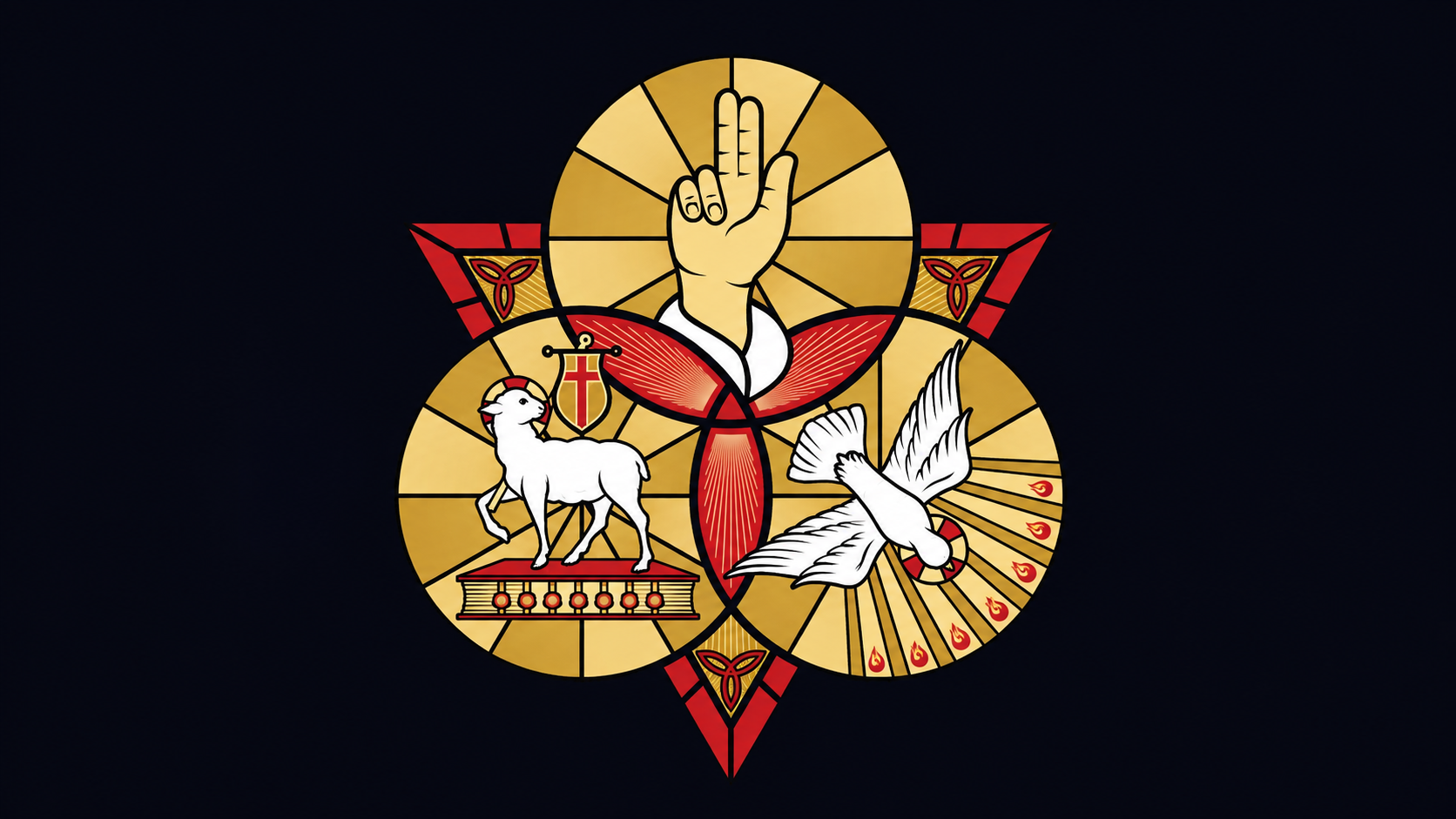
One substance, three Persons. This is the summary of the doctrine of the Trinity—a doctrine that is foundational to the Christian faith. Christianity is fundamentally about knowing the one true and living God, and having a living relationship with Him. And, it is this biblical doctrine of the Trinity that captures and unfolds the identity of the God whom we worship and proclaim. The doctrine of the Trinity presents God as one substance, three Persons.
To begin with, the word “Trinity” itself does not appear in the Bible at all, but the truth it conveys—of God being one substance, three Persons—is woven into the biblical revelation. The Bible reveals a God who exists eternally and manifests in redemptive history as three distinct persons—Father, Son, and Holy Spirit. In Ephesians chapter one, Paul explains the works of the three divine Persons in redemption: the Father willed humanity’s redemption, the Son accomplished it through His death, and the Holy Spirit applies it to everyone who believes in Christ.
Yet, the doctrine of the Trinity is also greatly misunderstood, and is the most controversial of the doctrines of Christianity. It is vehemently opposed by Muslims, atheists, the Mormons, the Jehovah’s Witness, etc. As a matter of fact, many Christians only accept the doctrine of the trinity by faith, not because they understand it.
However, while the Christian life is faith-based, where we relate to God through faith, and accept all that He has revealed about Himself in the Bible by faith, it is also crucial that we have the understanding of who He is. While faith makes God personal to us, understanding helps our witness of Him to the world (Matthew 28:19–20).
In this article, which is a pillar post, we will examine the biblical revelation of God as “one substance, three Persons”, investigate the allegation that the doctrine of the Trinity is a later invention at the council of Nicea, and answer the question “How can God be three Persons?”.
One Substance, Three Persons: What The Doctrine Of The Trinity Really Teaches

The doctrine of the Trinity affirms one true and living God who exists eternally as three Persons. The Bible does not teach three independent Gods who agreed to form a divine committee to govern the earth. The biblical Trinity is not the same as the triads found in many ancient religions.
The Language of Divine Plurality in Scripture
Fundamentally, Christianity, with its roots in the Old Testament self-revelation of God, is monotheistic. The Bible declares:
“Hear, O Israel: The LORD our God, the LORD is one!” (Deuteronomy 6:4)
Throughout, Scripture unequivocally declares that there is only one God (Isaiah 45:5; 1 Timothy 2:5). Yet within that oneness lies an unmistakable plurality. For example, in Deuteronomy 6:4, the word “one” is translated from the Hebrew ‘echad (pronounced ehhad).
The Hebrew language has a couple other terms for “one”. One is yachid (pronounced yahhid), which means solitary, only, unique. It is the word one will use if one was talking about an only child. Another word is bad, which is usec when speaking of being alone or being by oneself. But the term that God inspired to be used in Deuteronomy 6:4 is ‘echad, which signifies a united plurality. The term is also used in Genesis 2:24 where the Bible speaks of the oneness of a husband and wife. God being ‘echad, therefore, hints at His plurality.
The truth of the divine plurality appeared in the Bible’s very first chapter. The Hebrew word translated to God itself throughout the Old Testament, which first appeared in Genesis chapter one, is Elohim, the plural form of Eloha. This word itself hints at the divine plurality.
Another major evidence for the divine plurality appears in Genesis 1:26. There Scripture says:
“Then God said, “Let Us make man in Our image, according to Our likeness…”
From the knowledge of basic English language, the expressions “Let us”, “Our image”, and “Our likeness” implies divine plurality. The same expression also appears in Genesis 11:6, where God said during the building of the tower of Babel:
“Come, let Us go down and there confuse their language…”
These are not merely plural of majesty as some claim, but God’s intentional revelation of what and who He really is. As biblical revelation progressed, the divine plurality increasingly became clearer, reaching its full disclosure in the New Testament.
One Substance, Three Persons
The doctrine of the Trinity presents us with two truths. One, God is one in being. The being of God refers to the essence, substance, or quality that makes Him what He is. The word “God” is not a name per se. Rather, it describes the essence or substance of the one true and living Supreme Being. God describes the divine essence or substance.
Two, God is three in Persons. As Bible scholars say, “person” refers to the essence, substance, or quality that makes God whom He is. Scripture identifies three personally distinct Persons who have eternally co-existed and possess the divine substance equally. While the New Testament identifies the three divine Persons as Father, Son, and Holy Spirit, the revelation of their existence and co-operation began from the Old Testament.
The three divine Persons are personally distinct from one another. They are not parts of God or different manifestations of God in redemptive history. Scripture reveals them distinctly while affirming their oneness. In Matthew 3:13–17, while the Son was being bodily baptized in water, the Spirit descended upon Him, and the Father spoke from heaven, affirming the Son.
Ultimately, the three Persons are divine. That is, they are God (note: not Gods). The Father is God (John 6:27). The Son is God (John 1:1). The Holy Spirit is God (Acts 5:3–4; Ephesians 4:30).
Oneness That Defies Logic
Christianity does not preach three independent Gods. The doctrine of the Trinity affirms three personally distinct divine Persons. Within that divine plurality, however, exists a oneness that defies human reasoning, such that we do not have three Gods, but one God. This is a mystery of the Godhead.
What existed in the Godhead is far beyond unity or union. It is oneness. Jesus declares:
“I and My Father are one.” (John 10:30)
Likewise, in John 17:20–22, the Lord prayed for those who follow Him that we might be one, just as He and the Father are one.
These scriptures do not imply that the Father and the Son are the same person, in the sense that modal theorists teach. The oneness refers to their divine substance. Just as the Father possesses the divine substance so does the Son possess the divine substance. The Jews understood these utterances as Jesus claiming equality with the Father, prompting them to attempt to stone Him (John 10:31–33).
The oneness existing in the Godhead is such that they are not sought separately, or worshipped separately. A relationship with one brings a person into relationship with the others. Jesus states this explicitly in John 14:9 when answering Philip’s request to show them the Father:
“…Have I been with you so long, and yet you have not known Me, Philip? He who has seen Me has seen the Father; so how can you say, ‘Show us the Father’? (John 14:9)
Christianity does not worship the Father, Son, and Holy Spirit separately, in different ways, or through different means. They are one in substance, equally sharing attributes, purposes, authority, and worship. Scripture places the three divine Persons together in contexts of authority and worship. Jesus commanded that converts be baptized “in the name of the Father and of the Son and of the Holy Spirit” (Matthew 28:19). Remarkably, “name” is singular, yet three Persons are listed—an unmistakable pointer to oneness of the three divine Persons.
These are the truths that the doctrine of the Trinity holds together: the one true and living God who exists eternally as three personally distinct Persons who are co-equal.
Suggested Article: The Only Begotten Son of God: Compelling Biblical Proof That Jesus Is Truly Divine
A Later Theological Innovation?

One of the objections to the doctrine of the Trinity is the claim that it was a later invention. Some say that Christianity did not originally teach a Triune God. Rather, Christians introduced the idea as a theological innovation and invented the term Trinity after the apostles, at the council of Nicea. But that is far from the truth.
The English word Trinity comes through Latin Trinitas, meaning “threeness”. The Greek equivalent is Trias. The term Trias appeared in Christian theology as early as AD 180, when Theophilus of Antioch, in his To Autolycus, used the “Trinity” in connection with God, His Word, and His Wisdom.
At the beginning of the third century, Tertullian, in his Against Praxeas written in Latin, used the term Trinitas to defend the distinction between the Father, Son, and Holy Spirit while upholding the oneness of God. He described the one divine reality as existing in “one substance, three Persons.”
Therefore, “Trinity” did not first appear at the council of Nicea. While it had not yet become widely used, the term had existed, and the truth of God it contains had been well established within Christianity, long before Nicea.
The Council of Nicea
From its inception, Christianity was religio illicita—unlawful religion—within the Roman Empire. Christians didn’t have the recognition that pagan Roman religions had. Their refusal to participate in pagan sacrifices and the imperial cult brought them into conflict with the authorities. They suffered great persecution in every part of the empire.
But things changed dramatically under Emperor Constantine, who had converted to Christianity. In AD 313, through the popular Edict of Milan, he granted Christians and others freedom of religious practice. Emperor Constantine subsequently became an important patron of Christianity.
Prior to AD 313, Christians had never been able to hold councils to address the doctrinal controversies arising in the body. But in AD 325, Constantine convened a council of bishops from every part of the empire in the city of Nicea, Bythinia (today’s Turkey), because of a controversy that was sweeping through the churches in the empire concerning Christ’s divine status.
A preacher—Arius, from Alexandria, was teaching that Christ was not eternal in the same sense as the Father, and was a creature— the highest and first of God’s creations. This position, known in church history as Arianism, teaches that there was a time when Christ was not. It denied that the Son shared the same divine essence as the Father.
It was a serious controversy that touched the heart of Christian salvation and worship. If Christ is not truly God, then Christian salvation and worship became questionable. But the bishop of Alexandria—Alexander, opposed Arius, maintaining that the Son had eternally existed with the Father and was truly divine.
Arius’s teachings spread and became a major controversy throughout the Eastern Roman Empire. Constantine became involved because of the division occurring within churches of the empire. Christianity had become the state religion. That division therefore could threaten the empire’s stability. Thus, he summoned a council of Christian leaders to iron out the controversy.
However, Constantine did not participate in the discourses, nor did he propose the “Trinity” as claimed. The actual discourses were held by the bishops. The central issue at Nicaea was not even whether Christians should adopt the Trinity. It was the divine status of the Son in relation to the Father: Is the Son a creature or has He eternally co-existed with the Father?
Arius defended his position at the council. And, other theologians debated him in light of Scripture and the church’s received tradition. At the end, the council denounced Arius and affirmed the full and eternal deity of the Son, producing a Creed proclaiming Christ as:
“God from God, Light from Light, true God from true God, begotten, not made, of one substance with the Father.”
What happened at Nicea therefore was not the invention of the doctrine of the Trinity. Rather it was the articulation of a doctrine that is deeply entrenched in Scripture and which Christian communities have believed since the inception of the church.
Then, Nicaea did not conclude the discussion of the doctrine of the Trinity. The doctrine continued to be discussed, particularly regarding the status of the Holy Spirit and the precise relationship of the three divine Persons. The doctrine was further clarified at the Council of Constantinople in AD 381.
How Can God Be Three Persons?

Another objection to the doctrine of the Trinity is the question “How can God be three Persons?” To this question we can ask a counter question: Why can God not be three Persons?
The question “How can God be three persons?” smacks of arrogance. Many times, humanity thinks it knows God well enough that it knows what God should look like and be like. We forget our finiteness and carry ourselves beyond its rightful place.
Finite humanity does not possess the ability to understand the nature of the infinite God by itself, outside His self-revelation and the work of His grace.
God is transcendent. This means that He is completely distinct from, above, and independent of His creations. He exists outside of space, time, physical limits, and humanity’s reach and comprehension.
David declares:
“The LORD is exalted over all the nations, his glory above the heavens. Who is like the LORD our God, the One who sits enthroned on high, who stoops down to look on the heavens and the earth?” (Psalm 113:4–6)
God’s transcendence makes God unknowable. Except He makes Himself known, humanity cannot know Him. God, however, wants us to know Him because that is foundational to having a relationship with Him. He created us to glorify Him and to enjoy fellowship with Him eternally.
God, therefore, has graciously made Himself known, generally through creation, and specially through the Bible. The Bible is His special self-revelation in which He has revealed everything about Him that He wanted us to know—His name, character, nature, will, and redemptive purposes.
This means that if God reveals Himself as a Triune being, then that is what He is. It takes a special kind of arrogance to oppose what God has revealed about Himself. The Sovereign God decides what and who He chooses to be.
Yet, despite God’s self-revelation, humanity continues to struggle to understand and accept God’s identity. And, Scripture explains why. It describes fallen humanity as hopelessly confused, and their minds full of darkness, closed and hardened against God (Ephesians 4:17–18; Romans 1:18–22).
The apostle Paul states that fallen man apart from the regeneration work of God “does not receive the things of the Spirit of God, for they are foolishness to him; nor can he know them, because they are spiritually discerned” (1 Corinthians 2:14).
Regeneration is a work of divine grace by which God makes alive the heart and mind of the sinner, by which they receive the ability to comprehend and to respond to divine truths. When God regenerates a person, the covering of darkness over the heart is removed, and the light of the knowledge of God is able to penetrate their hearts (2 Corinthians 3:3–6).
Conclusion
The doctrine of the Trinity is fundamental to the Christian faith because it concerns the identity of the one true and living God whom we worship and proclaim. The word “Trinity” itself does not appear in the Bible, yet the truth of three divine Persons who co-exist eternally runs throughout the biblical revelation. The doctrine of the Trinity affirms God as one substance, three Persons.
The doctrine of the Trinity affirms that God is one in essence but three in Persons—the Father, Son, and Holy Spirit. All the three fully and equally possess the divine essence, making all the three God.
However, the Bible never presents three distinct Gods who have to be known and worshipped differently. Among the three divine Persons exists a oneness that defies human reasoning. They have everything in common—nature, attributes, will, purposes, authority, and glory.
Contrary to some opinion, the Trinity was not a later theological innovation at Nicea. It had existed in the Old Testament long before Christianity. The Nicene council only affirmed and articulated a belief that the apostles taught, and which Christians have held as sacred from the inception of the church.
Those who object to God’s Triune identity often ask, “How can God be three Persons?” The question reeks of pride, making humans look like we are powerful enough to decide what God should be. But it is beyond our ability to know God by ourselves. Except God has been gracious to reveal Himself, we could never have known anything about Him.
God has revealed Himself in the Bible as a Triune Being. And, that is what and who He is. It is not our place to object. Rather, we should humble ourselves and submit ourselves to what God has revealed about Himself, while we keep pursuing to understand Him.
As we continually study God’s revealed truth, we will increasingly grow in our understanding of this awesome God. Nevertheless, no matter how much we try, we will never get to know all that there is to know about God in this world. However, when Christ finally returns, we will know all there is to know about the Godhead.