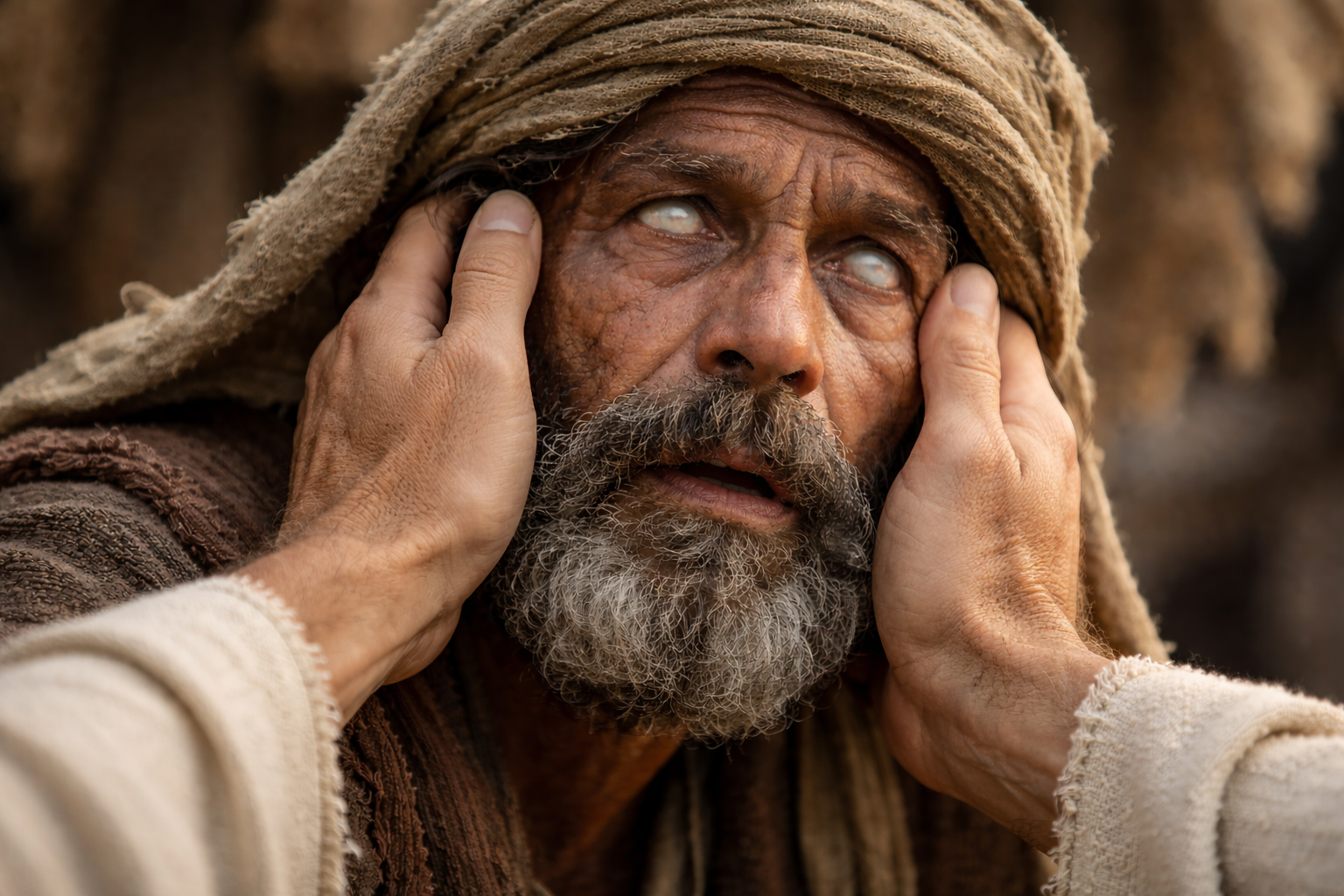
From Darkness To Light
Among the most feared conditions in human experience is blindness. And, this fear is not unreasonable. To lose one’s sight is to lose orientation, certainty, and independence; to be in darkness, where one must grope, uncertain of what lies ahead. The Bible employs this physical reality to reveal a far deeper truth about the human condition: the spiritual blindness of fallen humanity.
From the earliest pages of redemptive history, this truth is evident. Though created in the light of God, the Fall plunged humanity into intellectual, moral, and spiritual darkness. We grope for meaning, and yet remain unable to perceive the glory of God as we ought. The problem is not merely lack of information; it is that we lack illumination.
It is within this context that Jesus’ ministry emerges with striking clarity. His miracles were never random power displays, nor merely acts of compassion. They were signs—visible pointers to an invisible reality. Among these miracles, one stands out with profound theological weight: the opening of blind eyes.
When Jesus healed the blind, He was doing more than restoring a physical faculty. He was announcing the arrival of light in the world, fulfilling what prophet Isaiah foretold, that in the age of salvation, “the eyes of the blind shall be opened” (Isaiah 35:5). Jesus’ opening of blind eyes is not incidental; it is deeply intentional, pointing to a greater work of redemption—the leading of humanity from darkness to light.
Repeatedly in the Gospels, those who were blind came to see, not only with the eyes, but with faith. Conversely, those who presumed they could see—religious men confident in their own righteousness, remained in darkness. This reversal is not trivial. It reveals a central truth of Christ’s mission: He came not only to heal the blind, but to expose blindness—and ultimately, to lead men from darkness to light.
This article explores that redemptive purpose. Why did Jesus so deliberately open blind eyes? What do these miracles reveal about the nature of salvation? And how does this movement—from darkness to light—continue to define the experience of every true believer?
To answer these questions, we must look beyond the miracle itself and behold what it signifies: the gracious work of Christ, who alone can open the eyes of the blind and bring sinners into the light of God.
RECOMMENDATION: UNDERSTANDING GOD’S MOTIVATION IN SALVATION
The Prophetic Promise To Move Humanity From Darkness to Light

Long before Jesus came, the opening of blind eyes was already embedded within the Messianic hope. His giving of sight was not merely a miracle to be admired, but a sign to be recognized—a divine marker indicating the arrival of God’s salvation.
This was made unmistakably clear through the prophet Isaiah. In a passage rich with Messianic promise—Isaiah 35:4–5—the prophet declares:
4 Say to those who are fearful-hearted, ‘Be strong, do not fear! Behold, your God will come with vengeance, with the recompense of God; He will come and save you.’ 5 Then the eyes of the blind shall be opened, and the ears of the deaf shall be unstopped.
This is not an isolated statement, but part of an extensive vision in which creation itself is renewed, sorrow ends, and God comes to save His people. Within that vision, the opening of blind eyes stands as a defining feature of the Messianic age.
Isaiah, even more explicitly, records the words of the LORD concerning the Messiah:
6 I, the Lord, have called You in righteousness, and will hold Your hand; I will keep You and give You as a covenant to the people, as a light to the Gentiles, 7 To open blind eyes, to bring out prisoners from the prison, those who sit in darkness from the prison house. (Isaiah 42:6–7)
Here, the mission is both physical and spiritual. The Messiah will both restore sight and liberate those held captive in darkness. Therefore, blindness is not merely a medical condition, but a theological metaphor for humanity’s spiritual bondage.
This prophecy is particularly significant because such works were not characteristic of Old Testament prophetic ministries. While miracles did occur, the consistent opening of blind eyes was not a defining mark. This created a unique expectation: when the Messiah comes, He will be unmistakable—not only by what He says, but also by what He does.
Thus, when Jesus began the opening of blind eyes, He was fulfilling Scripture. Each miracle was a sign that the promised light has dawned, and that those who sit in darkness are now being invited to see.
Why Jesus Opened Blind Eyes in His Ministry
Having established that the opening of blind eyes was a clear Messianic expectation, we now consider why Jesus made this such a recurring feature of His ministry. The answer reveals not only His identity, but the very nature of His redemptive work.
First, the opening of blind eyes served as a divine authentication of His Messiahship. When John the Baptist sent messengers to ask if Jesus was truly the Coming One, His response was not abstract, but evidential:
“Go and tell John the things which you hear and see: The blind see and the lame walk…” (Matthew 11:4–5)
Jesus pointed to His works as the fulfillment of Isaiah’s prophecy. The opening of blind eyes became a Messianic credential—a visible declaration that the promised age of salvation had arrived in His person.
Second, the miracles reveal Christ’s compassionate heart. The Gospels repeatedly portray Him as being “moved with compassion” toward human suffering (cf. Matthew 14:14). In the ancient world, blindness carried not only physical limitations, but also social marginalization and economic hardship. When Jesus restored sight, He entered into human brokenness and reversed its effects. Thus, redemption is not abstract; it is deeply personal and restorative.
Third, the opening of blind eyes serves as a manifestation of God’s Kingdom. The miracles are not isolated acts of power; they are signs that God’s reign is breaking into the world. Where God rules, darkness gives way to light, and disorder yields to restoration. Each healing testified that the Kingdom is not only proclaimed; it is demonstrated.
Most importantly, the miracles point to a deeper spiritual reality. A striking pattern flows throughput the Gospels: the blind often responded to Jesus with faith, while the religious elite who claimed to see remained spiritually blind. This paradox was most clearly expressed in John 9, where a man born blind came to see, while the Pharisees’ blindness was exposed.
In this way, Jesus’ works confront every observer with a searching question: Do we truly see? The miracles find its fullest meaning not in the restoration of physical sight, but in the awakening of the soul to the truth of who Christ is.
Thus, the opening of blind eyes is a multi-layered revelation, authenticating Jesus as the Messiah, demonstrating His compassion, manifesting the Kingdom, and calling all who witness it to transit from darkness to light.
The Reality of Spiritual Blindness in Fallen Humans

While the opening of blind eyes in Jesus’ ministry involved real physical restoration, the Gospels consistently press beyond the surface to reveal a deeper reality: physical blindness serves as a metaphor for humanity’s spiritual blindness.
The New Testament affirms this condition of the fallen human heart. Jesus described the religious elite of His day as ‘blind leaders of the blind’ (Matthew 15:14). Paul echoes the same truth in 2 Corinthians 4:3–4 and Ephesians 4:18, portraying a state in which individuals are unable to perceive or rightly respond to divine truth. This form of blindness affects the heart, the mind, and the will.
In this light, Jesus’ healing of the blind reveals far more than physical restoration—it exposes the true condition of the human heart. The account in John 9 illustrates this with striking clarity, particularly in the exchange that follows the miracle. The Pharisees, who interrogated the man who had received sight, displayed an increasing resistance to the truth. Despite their acclaimed spiritual insight, they failed to recognize the fulfillment of prophecy unfolding before their very eyes.
This contrast is intentional. The episode reveals a paradox that runs throughout the Gospels: those who admit their blindness received sight, while those who claimed to see remained in darkness. When the healed man met Jesus again, he went from limited perception to full perception, ultimately declaring his faith in Christ. In contrast, those who boasted of knowing Scripture rejected the evidence before them.
Jesus explained this paradox in John 9:39:
“For judgment I have come into this world, that those who do not see may see, and that those who see may be made blind.”
This is not about physical eyesight, but spiritual perception. The issue is not the absence of information, but the inability, and often the unwillingness, to perceive truth rightly. Therefore, spiritual blindness is characterized by:
- Inability to perceive divine truth despite clear evidence, due to a mind darkened by sin (Ephesians 4:18a).
- Resistance to divine truth, because of the hardness of the heart (Mark 16:14)
- Reliance on self-righteousness.
- Confidence in one’s own perceived insight apart from God.
In contrast, the man who received sight embodied the posture that leads to true vision: He acknowledged his need, responded to the revelation given, increased in understanding as truth unfolded, and ultimately embraced Christ. This movement, from darkness to light, is transformative, not merely intellectual. It reflects Christ’s redemptive work in opening the eyes of the heart.
Thus, the broader message of the Gospels becomes clear: blindness is a condition to be recognized. Only those who acknowledge their blindness are positioned to receive true sight. Those who insist they already see remain closed to the very light that can save them.
The opening of blind eyes is, deeply, a revelation of human need and divine provision. It confronts the reader with a searching question: Are you willing to acknowledge your blindness, or do you cling to the illusion that you already see?
The Redemptive Meaning of Jesus Opening Blind Eyes
Together, the prophetic background, the ministry of Jesus, and the Gospel narratives, converge to reveal a unified truth: the opening of blind eyes is not merely a miracle of healing; it is a revelation of redemption itself. In these acts, Jesus was not only restoring physical sight but also illustrating the deeper work He came to accomplish in the salvation of humanity.
At its core, redemption involves a decisive transition—from slavery to freedom, from death to life, and from darkness to light. Blindness serves as a fitting metaphor for the human condition under sin. Apart from God’s intervention, humanity is unable to perceive God’s truth, respond rightly to it, or walk in the fullness of His will. Into this darkness, Christ entered as the Light, bringing illumination.
Jesus consistently identifies Himself with light. In John 8:12, He declares:
“I am the light of the world. He who follows Me shall not walk in darkness, but have the light of life.”
Again, in John 9:5, in the context of healing the blind, He affirms this identity. Thus, bringing people from darkness to light is central to His redemptive mission. By opening blind eyes, Jesus shows that salvation is not only forgiveness, but also the restoration of spiritual sight. To be saved is to be brought into a new way of seeing the glory of God in Christ and responding in faith.
Each healing was a living illustration of what happens when a person encounters Christ: darkness is dispelled, confusion gives way to clarity, ignorance yields to understanding, and rejection changes to worship. This transformation is not self-generated; it is entirely the work of Christ. The individual contributes nothing to the opening of the eyes; we simply receive.
Thus, the opening of blind eyes underscores the grace-centered nature of salvation. The same God who commanded light to shine out of darkness is the One who shines in the human heart (2 Corinthians 4:6). Christ does not merely reveal truth externally—He enables it to be perceived internally.
Furthermore, these miracles point forward to the ultimate redemptive goal: a people who fully see God. The partial restorations witnessed in the Gospels anticipate a future reality where sight is complete, where faith gives way to sight, and where believers behold the glory of God without obscurity.
The opening of blind eyes, therefore, is not a peripheral theme—it is a window into the gospel itself. It encapsulates the movement of redemption: Christ entering a darkened world, confronting darkness with light, and transforming those who receive Him into people who truly see.
Christ Still Delivers From Darkness to Light Today
The ministry of Jesus did not end with the Gospels. While the physical opening of blind eyes was a sign unique to His earthly ministry, its spiritual reality continues in the present work of salvation. The same Christ still opens blind eyes, bringing sinners from darkness to light.
This transformation begins at the new birth. As Jesus declares in John 3:3, “Unless one is born again, he cannot see…” Salvation involves a radical transformation of the heart, not mere moral reform. God replaces the sinful, hardened, and darkened heart with a new one (Ezekiel 36:26–28), thus activating the capacity for true spiritual perception.
This inward transformation is entirely the work of God. In the new birth, humans are acted upon. Just as Jesus opened blind eyes apart from the contribution of the blind, so He opens the eyes of the heart by grace. Faith is not the cause of this work, but its evidence.
Yet this new spiritual sight is not static; it grows. Paul’s prayer in Ephesians 1:15–18 shows that believers continue to be enlightened. Spiritual perception deepens over time as the believer grows in Christ. We come to see more clearly, to discern more accurately, and to walk more faithfully.
Even so, a tension remains. Though we have been brought into the light, we still live in a world marked by darkness. We are therefore called to walk as “children of light” (Ephesians 5:8), resisting what distorts truth and clouds perception.
The ongoing work of Christ is a testament to the fact that the same power that opened blind eyes in the Gospels is still at work today, not in identical outward signs, but in the inward transformation of lives once marked by spiritual blindness. Each conversion is another testimony that the light has not dimmed and the redemptive mission of Christ continues. He is still opening blind eyes.
The Call From Darkness to Light

From the prophecy of Isaiah to the lived reality of the Gospels, a single thread runs consistently through: God’s intention to bring humanity from darkness to light through Christ’s redemptive work. What began as a physical miracle ultimately points to a spiritual reality that lies at the heart of the gospel itself.
Jesus did not open blind eyes merely to display power, nor simply to relieve suffering—though He certainly did both. Each restored sight served as a sign that the Messianic age had arrived. In fulfilling Isaiah’s words, Christ revealed Himself as the One who not only heals the body but also transforms the soul. In Him, the blind see, and those who sit in darkness see light.
Yet these miracles confront every human with a personal reality. The question is not whether we see physically, but whether we truly see God as He has revealed Himself. The Gospels consistently show that those who admit their blindness receive sight, while those who claim to see remain blind. True sight is not attained by intellect, effort, or status; it is granted by grace.
Thus, to move from darkness to light is to admit one’s blindness, respond in faith to Christ, and submit to His revelation. It is to abandon self-reliance and trust in the One who is the Light of the world. Ultimately, the opening of blind eyes is an invitation to experience transformation. The same Christ who once opened physical eyes now opens spiritual ones.
And so the question remains: having been confronted with the light of Christ, will we remain in darkness, or will we embrace true sight?
Further Resources:
- GotQuestions.org—Why Did Jesus Heal the Blind?
- Desiring God—I Was Blind, Now I See
- Ligonier Ministries—Jesus Heals the Blind Man
- Bible.org—The Healing of the Man Born Blind (John 9)