Introduction
The doctrine of the Trinity is Christianity’s core doctrine. It concerns the identity of the one true God whom we worship and proclaim. However, the concept of threefold representations of the divine is not exclusive to Christianity. It was also present in many ancient religions. Therefore, a question naturally arises: Why does Christianity share similar pattern with ancient religions?
The popular answer, especially in comparative religious studies, is that Christianity only copied the Trinity from ancient pagan religions. The argument is that the Father, Son, and Holy Spirit are the Christianized version of ancient religious triads. This can be unsettling for any Christian.
Yet the argument rests on a misunderstanding of Christianity’s actual teaching about God. The doctrine of the Trinity does not teach three independent gods who form a divine council, which is actually what the ancient triads are. Christianity’s teaching about God, based upon His self-revelation in the Bible, is unparalleled in the religious landscape of the ancient times.
Therefore, the presence of triads in ancient pagan religions does not automatically undermine Christianity’s doctrine of the Trinity. Rather, it invites an honest probe. Why did ancient people so often gravitate toward threefold representations of the divine? Is this similarity accidental, copied, or deeper? And, in what ways does the Christian Trinity differ from other ancient triads? These are the issues that this article—The Uniqueness of the Trinity—seeks to examine.
The Trinity Vs. The Ancient Triads
A fundamental error in discussions about the Trinity is the assumption that any grouping of three divine figures is essentially the same as the Trinity. This assumption undermines a crucial theological distinction. While many ancient religions have triads, only Christianity proclaims the Trinity. The difference is not merely semantic—it is foundational.
What the Trinity Really is
The doctrine of the Trinity affirms a God who exists eternally as three Persons. Throughout, Scripture unequivocally declares that there is only one God.
“Hear, O Israel: The LORD our God, the LORD is one!” (Deuteronomy 6:4)
Yet within that oneness lies a clear plurality. Of the handful of Hebrew words for “one”, the word used in Deuteronomy 6:4 is ‘echad (pronounced ehhad), which denotes a united plurality. It is the term used in Genesis 2:24 where God called the husband and wife one flesh. Thus, God being ‘echad hints at divine plurality.
This truth of divine plurality is apparent throughout biblical revelation, from the Hebrew word for God—Elohim, which is plural, to God addressing Himself in plural terms such as “Let Us make man in Our image, according to Our likeness…” (Genesis 1:26.
The doctrine of the Trinity teaches a God who is one substance but three Persons. “God” is not a name. It describes the divine essence. And, Scripture identifies three eternally existing Persons who possess “Godness”— the Father, Son, and Holy Spirit. It means that the Father is God (John 6:27), the Son is God (John 1:1), and the Holy Spirit is God (Acts 5:3–4; Ephesians 4:30).
The three Persons are not different divine manifestations in redemptive history. They are personally distinct from one another. In Matthew 3:13–17, the Son was baptized in water, the Spirit came upon Him, and the Father spoke from heaven.
Yet, within that plurality exists a oneness that beats logic, so that they are not three Gods, but one God. This is a mystery. Jesus consistently declared His oneness with the Father (John 10:30; John 17:20–22. This does not mean they are one person. It is about their Godness. The Son is equally God like the Father.
The oneness of the three Persons of the Trinity—the Father, Son, and Holy Spirit—lies in their shared essence, attributes, will, purposes, authority, and glory. In His high priestly prayer before His crucifixion, Jesus prayed to the Father saying:
“And now, O Father, glorify Me together with Yourself, with the glory which I had with You before the world was.” (John 17:5).
What a Divine Triad is
A divine triad refers to a grouping of three gods in ancient cultures, who govern a realm together. Such triads often appeared as familial triads—father, mother, and child, cosmic triads—sky, earth, and underworld, or functional triads: creation, preservation, destruction.
These triads explained every occurrence, legitimized kingship, originated myths, and inspired worship within cultures. Importantly, the triad members were typically distinct beings with separate origins, characters, and spheres of influence. They could cooperate, compete, or even oppose one another.
In triads, association is functional, not ontological. The gods are united by function—not by shared essence.
The Uniqueness Of The Trinity
The Christian Trinity stands apart from all divine triads at several decisive points.
First, the Trinity affirms one divine essence. But the triads are merely groups of different beings forming a divine council.
Second, the triads consist of the three major deities from the pantheon of deities. But, aside from the Persons of the Trinity, no other deities exist in Christianity.
Third, the three Persons of the Trinity are co-equal. None is subordinate in nature (John 17:5). But the triads involved hierarchy, generation, or temporal succession.
Additionally, the oneness within the Trinity is ontological. The Father, Son, and Holy Spirit do not merely work together, they are one essence. While personally distinct, they act as a single divine agent. For example, in salvation. But the triads’ unity is only functional, a mere working relationship.
Furthermore, the triads often involved moral deficiency, rivalry, and succession—traits not found in the Trinity (Numbers 23:19; Malachi 3:6). The Trinity is morally and relational coherent.
Finally, the Persons of the Trinity are not worshipped separately. Christians do not worship three gods. A relationship with one brings a person into relationship with the others (John 14:9). But the triads’ members are worshipped separately and differently. Each had its own temples, priesthood, and protocols.
Failing to make this distinction results in serious theological confusion. If the Trinity is reduced to a triad, Christianity becomes either polytheistic or mythological. But Scripture rejects both options. The biblical God is singular in being and incomparable in nature (Isaiah 40:18).
This distinction also explains why early Christians—despite living in a time filled with triads—were accused of, and also persecuted for rejecting polytheism. They were not proclaiming a familiar pagan pattern in Christian language; they were announcing something radically different: one God who exists eternally as three Persons.
Examples Of Ancient Triads
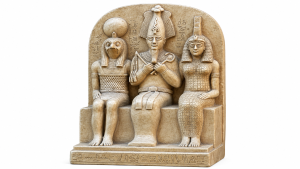
The Kemites’ Triads
Among all ancient civilizations, Kemet, ancient Egypt, is most frequently cited. This is because Egyptian religion developed some of the most sophisticated theological structures of the ancient world, including divine triads that appear, at first glance, strikingly similar to Christian language about Father, Son, and Spirit. However, a closer examination shows that these similarities are structural and symbolic, not theological or ontological.
Egyptian triads were typically localized. Each major city had its own grouping of three major deities. These triads usually followed a familial pattern, reflecting human social structures rather than divine self-revelation.
Some of the most well-known examples include:
Osiris, Isis, and Horus
Osiris was a god of kingship and the afterlife, Isis was a goddess of magic and motherhood, and Horus, their son, was associated with royal authority.
Amun, Mut, Khonsu (The Theban Triad)
Amun was elevated as a chief deity, Mut as his consort, and Khonsu as their offspring, often associated with the moon.
Ptah, Sekhmet, Nefertum (The Memphite Triad)
Ptah was a creator god, Sekhmet a warrior goddess, and Nefertum a god of healing and rebirth.
The resemblance between Egyptian triads and the Christian Trinity is merely superficial. First, Egyptian triads are biologically and generationally structured. A god and a goddess mate, give birth, and transfer authority through lineage. This contrasts with the biblical God, who is eternal, uncreated, and without origin (Psalm 90:2).
Second, the Egyptian triads’ members are separate beings, not one shared essence; none fully possess the being of the others. But Scripture affirms that all the Persons of the Trinity share fully in the divine nature (Colossians 2:9).
Third, Egyptian gods are morally and ontologically limited. They can be deceived, harmed, killed, or raised through magic. For example, Osiris was murdered and reassembled. But the God of Scripture is not like that (Malachi 3:6; Numbers 23:19).
Fourth, Egyptian triads operate by hierarchy and dependency. But the Trinity presents relational distinction with equality (John 10:30).
Nevertheless, the Egyptian triads, though borne out of mere superstition, reveal profound human intuitions about the divine. They reveal that:
- Ultimate reality involves unity and plurality.
- Divine mediation is necessary between heaven and earth.
- Leadership, order, and life flow from a higher, unseen source.
These insights reflect what theologians call general revelation: divine truths accessible to humanity through creation and conscience (Romans 1:19–20). Yet general revelation, while real, is insufficient. It produces awareness of the divine but cannot fully disclose God.
What Egyptian religion sought symbolically, God has revealed personally and historically in Christ (Hebrews 1:1–2). Thus, Egyptian triads are best understood not as sources of the Trinity, but as human attempts to express a divine reality that would only later be fully revealed.
Other Ancient Triads
Mesopotamia
Ancient Mesopotamia, particularly the Sumerians and Babylonians, had its own triads:
Anu—god of the heavens and supreme authority.
Enlil—god of air and governance.
Enki—god of waters, wisdom, and craft.
These deities oversee different cosmic domains and only worked together to maintain order. But their unity was not essential. Each god possessed a distinct personality and agenda. They could be outwitted, opposed, or limited by one another.
Hinduism
Perhaps the most frequently invoked comparison to the Christian Trinity is Hinduism’s Trimurti, composed of:
Brahma—The creator.
Vishnu—The preserver.
Shiva—The destroyer or transformer.
The Trimurti represents functional roles, not a shared divine essence. In practice, the three are worshiped separately, unequally, and within vastly different theological systems across Hindu traditions. Moreover, Hinduism often oscillates between polytheism and monism, not Trinitarian personalism.
Greco-Roman Triads
The Greco-Roman world also organized its pantheon in threes. Notable examples include:
Zeus, Poseidon, and Hades—rulers of sky, sea, and underworld.
Jupiter, Juno, and Minerva—the Capitoline Triad of Rome.
These triads functioned politically and cosmologically, but they were deeply anthropomorphic. The gods quarreled, deceived one another, and behaved in morally inconsistent ways.
The Pattern Beneath the Patterns
Across these diverse cultures, a theme remains consistent: humanity sensed that ultimate reality could not be reduced to a single, flat category. Power, wisdom, order, and life seemed to demand divine explanation. Yet without God’s self-disclosure, these intuitions distorted God’s true Triune nature.
Scripture explains this phenomenon soberly. Humanity possesses some knowledge of God, but that knowledge is partial and often distorted. Romans 1:21 says:
“Because, although they knew God, they did not glorify Him as God…”
Triadic structures reflect real perception mixed with human limitation. They are witnesses to humanity’s search.
Why Triads Appear In Ancient Religions
A crucial question naturally arises at this point: If Christianity did not borrow the Trinity from earlier religions, then why do echoes of threefold deities appear so consistently across cultures? The answer lies not in imitation, but in revelation.
Firstly, humanity, even in the days before the Bible, possesses an innate consciousness of God, through creation. Theologians call this general revelation of God.
Romans 1:19–20 says:
“For what may be known of God is manifest in them, for God has shown it to them. For since the creation of the world His invisible attributes are clearly seen.”
Ancient peoples were not inventing gods in a vacuum. They were responding, though imperfectly, to real innate awareness of God. The Fall didn’t erase man’s memories of God; it distorted them. The triadic structures were creations of residual memories of God, attempts to articulate a transcendent reality, which humanity lacked the clarity required to express accurately.
While general revelation provides some knowledge of God, it doesn’t reveal God’s inner life. It reveals God’s existence, power, and wisdom, but not God’s actual form. Such depth of knowledge requires special revelation, which has now been fully revealed through Christ (John 1:18). Thus, ancient triads pointed toward truth without possessing the truth.
Secondly, because humanity is made in God’s image (Genesis 1:26), human thought, society, and symbolism naturally reflect relational complexity, according to God’s own relational nature. Even apart from explicit theology, humans instinctively organize meaning in patterns of relationship:
- Source, expression, and fulfillment.
- Authority, mediation, and presence.
- Origin, continuity, and destiny.
These patterns are not arbitrary. They mirror a reality that Scripture later reveals fully: God is eternally Father, Son, and Spirit. Long before this was articulated doctrinally, it was intuited existentially.
The Christian Trinity was not copied. It was the full realization of an inate awareness of the divine that ancient people could not shake off. Humanity had long sensed that the divine reality was richer than solitary oneness. Thus, ancient triads don’t undermine Christianity’s proclamation of God as a Triune Being. They are its natural evidence.
Why the Christian Trinity Is Unique
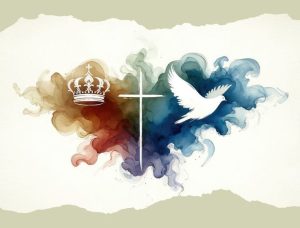
Still, we have another crucial question to answer—a decisive question: What makes the Christian Trinity fundamentally different? Let’s consider a few distinctions of the Trinity.
1. The Trinity Was Revealed, Not Discovered
Ancient religions arrived at triads through reflections, myths, or symbolic storytelling. But the knowledge of God’s triune nature came through biblical, historical revelation. The Trinity is known because God acted in history:
- The Father willed humanity’s redemption.
- The Son sacrificed Himself to redeem humanity.
- The Holy Spirit applies redemption, and indwells believers as proof of divine presence.
These are not abstract ideas but lived experiences. The apostles did not speculate their way into Trinitarian belief; they were confronted by it (1 John 1:3).
2. Christianity’s Jewish Roots
A very strong argument against Christianity borrowing the Trinity from pagan religions is Christianity’s Jewish roots. The earliest Christians were first-century Jews who were fiercely monotheistic, shaped by the Torah and the prophetic insistence that Jehovah alone is God (Isaiah 45:5). For such a people, adopting a pagan triad would have been unthinkable.
In fact, they were persecuted precisely because they rejected other nations’ gods. They did not reinvent pagan theology; they repudiated it. Yet these same monotheistic Jews worshiped Jesus, prayed in His name, and experienced the Spirit as divine. The doctrine of the Trinity arose because they were compelled to hold together three non-negotiable biblical truths:
- God is one.
- Jesus is fully God.
- The Holy Spirit is fully God.
The Trinity was not a choice; it was a necessity.
3. An Unprecedented Claim
No ancient religion ever claimed that three distinct persons share one identical divine essence, each person is fully God, and yet profoundly united. But Christianity does. Jesus speaks of oneness with the Father (John 10:31), and of a shared divine glory with Him (John 17:5). He speaks of the Holy Spirit as another of the same kind (John 14:16).
This is not mythology. It is metaphysical precision born out of revelation.
4. Moral and Relational Coherence
Ancient triads often portray gods in conflict, competing wills, moral failures, and internal instability. But the Christian Trinity reveals perfect unity of character, will, and purpose. The Trinity is not a divine committee; it is eternal communion.
5. The Fulfillment of Humanity’s Search
Rather than borrowing from ancient religions, in Christ, what the ancient religions sought but could not articulate was fulfilled. Now, through Christianity, it is being proclaimed. Paul told the Athenians that what they worshiped in ignorance, God had now made known (Acts 17:23). The ancient triads were humanity reaching upward; the Trinity is God reaching downward.
Conclusion
Humanity has long sensed the complex nature of the divine. Pagan religions expressed this awareness through triads, revealing man’s longing to relate with God. Yet, as insightful as they were, ancient triads were distortions of God’s truth.
The ancient triads do not undermine the truth of the Trinity; they confirm it. Christians can see in them confirmation of God’s self-revelation. They mirror God’s relational nature. Their shadows pale beside God’s self-revelation. The Trinity is not merely another triad grouping but the inner life of God which He Himself has revealed. The Father, Son, and Holy Spirit are real Persons, sharing one divine essence.
Christianity stands unique. It fulfills human longing to understand the divine, through God’s self-disclosure as three co-eternal and co-equal Persons. Ancient triads pointed toward truth; the Trinity is the truth. What humanity senses in the invisible has now been decisively revealed in the Trinity.
For those seeking truth, the study of the ancient triads can arouse awe at the depth of humanity’s spirituality, but it is the revelation of God that fosters genuine worship, faith, and salvation.
Further Reading: